
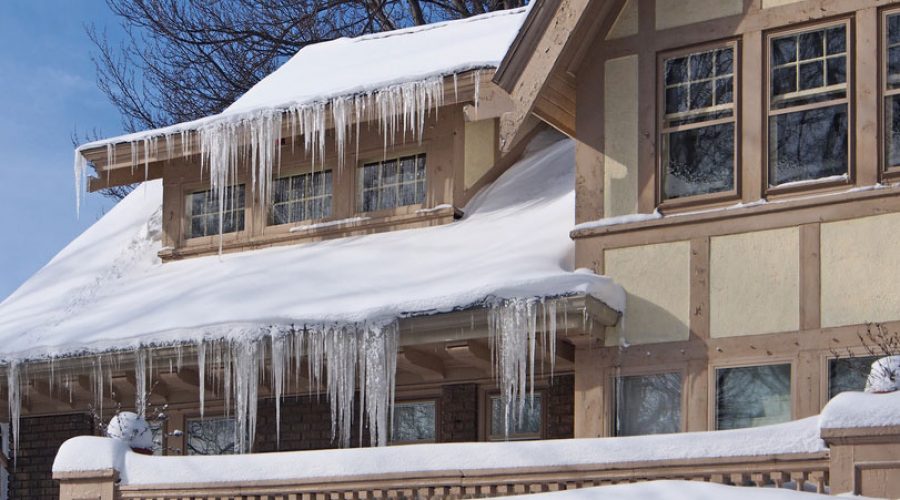
If you live in Chicago, you’re no stranger to snow and the storms that cover your home with it and create a snow roof load every Winter. We shovel snow from driveways, brush it off our cars, and pack it into snowmen for our children many times a year. But most of us rarely think about the effect of snow on our roofs.
Chicago winters are hard on roofs, and not just because of ice dams and shingles, but because snow is heavy. And the same snowfall can weigh wildly different amounts depending on whether it’s fluffy powder or wet, compacted slush.
It’s a good idea for all homeowners to understand snow roof load, how it works, what is safe and what is not, and how to make decisions about it.
What is “Snow Roof Load”?
When engineers talk about snow roof load, they’re talking about the weight pressing down on the roof because of accumulated snow, usually expressed in pounds per square foot (psf).
To determine the proper construction of a roof and its ability to withstand snow roof load, engineers start with calculations from “ground snow load (gsf).” The gsf is calculated based on the weight of snow on the ground, again, expressed in pounds per square foot (psf). It’s the regional baseline snow weight and is an important code/design value for your area based on statistical snow events.
The gsf must then be converted to the Roof Snow Load to understand what your roof is expected to carry after accounting for roof slope, wind exposure, drifting, heat loss, roof shape, and more.
The Americal Society of Civil Engineers (ASCE) Standard 7 then converts the gsf to roof load using formulas from a standard entitled “Minimum Design Loads and Associated Criteria for Buildings and Other Structures.” The ASCE factors in the necessary variables to consider for safe snow roof loads. These include:
- Roof slope (flat vs. steep)
- Exposure (windy vs. sheltered)
- Thermal conditions (heated vs. unheated buildings)
- Snow drifting (effects of valleys, parapets, roof step downs)
Because of these many varying conditions, the same snowfall can result in varying snow roof loads between houses. In other words, the safe snow roof load on your home may be different than your neighbor’s.
What is Safe Snow Roof Load?
Since snowfall varies between geographic areas, municipalities set their own safe snow roof loads. In DuPage County, where Pro-Home Services does most of its roofing and siding work, we are subject to the building codes of DuPage County. The guidelines set the safe ground snow load at 30 psf. This same ground snow load is echoed in specific village and city guidelines within the county, such as for safe snow roof load in Glen Ellyn, Illinois.
Snow Roof Load Variance by Snow Type
Anyone who has built a snowman or participated in a snowball fight will tell you that snow varies. An inch of light, fluffy snow weighs much less than wet, easy-to-pack, slushy snow. Indeed, when it comes to snow roof load, the greatest measurement that matters is the amount of snow water weight, not the inches of snow.
This measurement is known as Snow Water Equivalent (SWE) and is measured by how much water you have after the snow has melted. The National Weather Service notes the “old rule” that 10 inches of snow ≈ 1 inch of water (a 10:1 ratio), but also notes ratios vary and an average like 12:1 may be more representative in parts of the Upper Midwest. This calculation is useful in determining the psf snow roof load and gives some credence to when homeowners should be concerned about snow roof load.
The National Weather Service has calculated that measuring the meltwater of your snowfall can give you an educated estimate of the psf on your roof.
- 1 inch of water is equivalent ≈ 5.2 psf of load snowloads
So if your roof is holding snow that would melt down to:
- 2 inches SWE → ~10.4 psf
- 4 inches SWE → ~20.8 psf
- 6 inches SWE → ~31.2 psf
How to Measure Your Snow Roof Load
If you ever feel concerned about your roof snow load, there is a way to estimate it without too much complicated math.
Step 1: Measure snow depth in multiple spots
Use a yardstick from the ground, where possible, and note the depth of the snow that has fallen. Take note of your drifting at the roof edges, parapets, chimneys, and taller sections. Visually estimate or manually measure this depth.
Step 2: Estimate the water content (SWE) of the snowfall
Is the snow you measured light or heavy? Heavy snow packs easily into snowballs. It also develops with melting/refreezing or rain-on-snow.
Step 3: Convert to SWE (rough estimate)
If the snow is light and fluffy, the ratio will be closer to 12 inches of snow to one inch of water. If it is heavier, the ratio may be closer to 10:1. If you’re unsure, assume the snow is heavier than you think.
Then translate SWE into psf using the formula from the National Weather Service:
psf ≈ SWE(inches) × 5.2
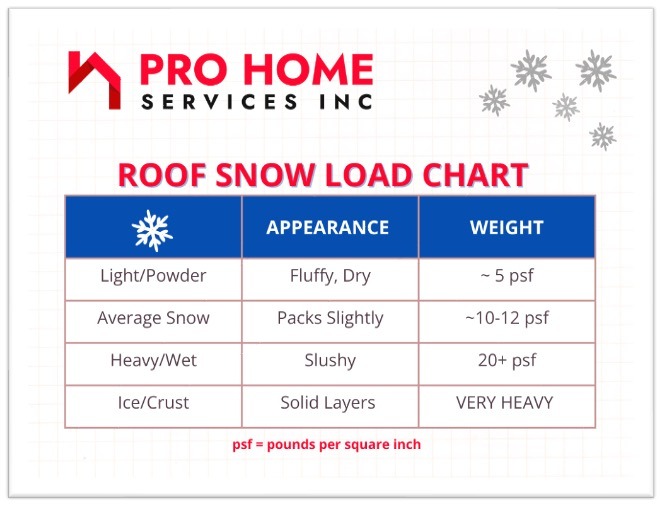
Below is a chart you can use that gives approximate psf for different types of snow. While you are still encouraged to measure and evaluate your own snow roof load for accuracy, it can give an approximation of what is happening on your roof given the type of snow on the ground.
Professional Help for Snow Roof Load
A wise homeowner keeps a close eye on their snow roof load during periods of intense winter weather. Beyond calculating your snow roof load, you should also be on the lookout for telltale signs that your roof may be buckling under the weight of the accumulated snow.
Call a qualified roofing contractor or structural professional if you notice:
- New or widening ceiling cracks
- Doors suddenly sticking (structure shifting)
- Loud creaks/pops from the roof/attic
- Sagging rooflines or bowing ceilings
- Significant drifting (deep piles in one area)
FEMA’s snow load safety guidance emphasizes that if you have concern a collapse could occur, stop removal activities and evacuate and get professional help. FEMA+1
Removal of Snow Roof Load
During the winter months, we at Pro-Home Services are very busy removing snow from people’s roofs when the roof load is a concern. However, we always encourage homeowners to remove snow themselves following careful guidelines to prevent damage to their shingles or roof structure. Typically, it’s as easy as raking the snow off the closest areas of the roof, which speeds snow melt and improves gutter flow.
When heavy snow begins to accumulate on your roof, remember the basics of snow roof load. If we can help you remove the snow or inspect your roof for unwieldy roof snow load, call us at 630-790-0800 or contact us.